Trump's 'Forced Labour' Tariffs on Canada Deserve More Scrutiny Than They're Getting
On July 28, 2026, the White House replaced an expiring 10 per cent tariff with a new regime that targets dozens of nations, Canada included, under the stated goal of combating forced labour in supply chains. The rebranding is deliberate. When a trade barrier is about to sunset and the administration replaces it with a nearly identical one using different legal language, you are watching protectionism find a new costume.
The forced labour justification matters because it sidesteps the normal trade dispute channels. Under USMCA, Canada has explicit prohibitions against importing goods made with forced labour. Bill S-211, passed in 2023, requires companies to report on forced labour risks in their supply chains. The law exists. The question isn't whether Canada has the rules. It's whether the U.S. administration believes those rules are enforced aggressively enough, or whether enforcement was ever the point.
The Compliance Trap
Even if a Canadian exporter uses no forced labour anywhere in its supply chain, these tariffs create a new burden: proving it. Rigorous audits cost money. Third-party certifications cost money. Detailed documentation at every tier of the supply chain costs money. That cost doesn't appear as a line item called "tariff." It shows up as higher overhead, tighter margins, and reduced competitiveness against domestic U.S. producers who face no equivalent burden of proof. Call it a shadow tariff. It works the same way.
The sectors most exposed, textiles, solar components, certain agricultural products, often have complex upstream inputs. A solar panel assembled in Ontario might use polysilicon traced back to Asia. A garment sewn in Montreal might use cotton processed through multiple countries. The tariff regime doesn't just penalize bad actors. It penalizes anyone whose supply chain is hard to audit, which in 2026 is nearly everyone operating at scale.
Strategic Decoupling by Another Name
The timing is revealing. These tariffs arrive as the three USMCA partners prepare for the treaty's formal joint review in 2026. Rather than let the previous 10 per cent duty lapse, the administration has found a rationale that is harder to challenge through standard trade dispute mechanisms. Forced labour is a human rights issue. Framing it that way makes it politically toxic for Canada to push back too hard, even when the economic impact is identical to a straightforward protectionist measure.
It also forces Canada into a choice: decouple from the same Asian suppliers the U.S. has blacklisted, or keep facing exclusion. The result is a de facto "Fortress North America" policy, where Canada must adopt U.S. enforcement priorities and supplier blacklists or absorb ongoing trade friction. That's not a partnership. That's alignment by coercion.
The Inflationary Boomerang
Here's what gets less attention: U.S. manufacturers who rely on intermediate Canadian components will pay these tariffs too. Border-state producers who source steel, aluminum, refined petroleum, or auto parts from Canada are about to see input costs rise. The tariff is designed to protect domestic industry, but it may end up harming the same constituencies it claims to serve. Inflation in both countries remains a live political issue. Adding friction to a $3.5 billion CAD per day trade relationship doesn't make that problem smaller.
Canada's historical response to U.S. tariffs has been dollar-for-dollar retaliation. If that pattern holds, American exporters are about to face their own compliance headaches. The forced labour framing might make for good domestic politics in Washington, but the arithmetic doesn't change. Tariffs raise prices. Retaliatory tariffs raise them further. Consumers on both sides of the border pay the tab.
The forced labour language is doing real rhetorical work here. It turns a trade dispute into a moral claim. That makes it harder to argue against without sounding indifferent to human rights. But the policy isn't new. It's the same 10 per cent duty with better branding and a compliance regime that functions as an additional tax on anyone with a multinational supply chain. If the goal were actually enforcement, you'd see targeted sanctions on specific exporters with documented violations. Instead, you're seeing a blanket measure that applies pressure everywhere and accountability nowhere.


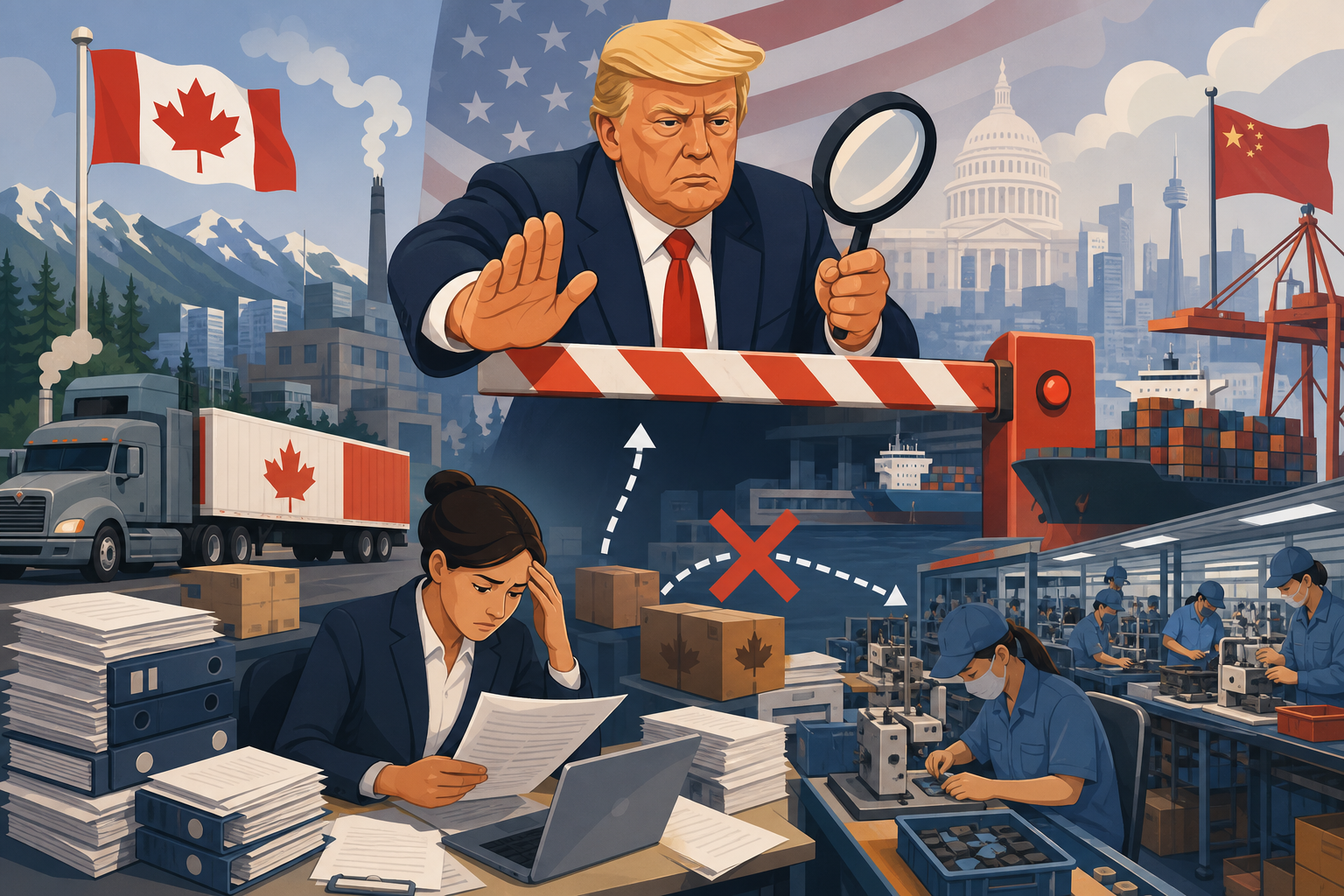

On July 28, 2026, the White House replaced an expiring 10 per cent tariff with a new regime that targets dozens of nations, Canada included, under the stated goal of combating forced labour in supply chains. The rebranding is deliberate. When a trade barrier is about to sunset and the administration replaces it with a nearly identical one using different legal language, you are watching protectionism find a new costume.
The forced labour justification matters because it sidesteps the normal trade dispute channels. Under USMCA, Canada has explicit prohibitions against importing goods made with forced labour. Bill S-211, passed in 2023, requires companies to report on forced labour risks in their supply chains. The law exists. The question isn't whether Canada has the rules. It's whether the U.S. administration believes those rules are enforced aggressively enough, or whether enforcement was ever the point.
The Compliance Trap
Even if a Canadian exporter uses no forced labour anywhere in its supply chain, these tariffs create a new burden: proving it. Rigorous audits cost money. Third-party certifications cost money. Detailed documentation at every tier of the supply chain costs money. That cost doesn't appear as a line item called "tariff." It shows up as higher overhead, tighter margins, and reduced competitiveness against domestic U.S. producers who face no equivalent burden of proof. Call it a shadow tariff. It works the same way.
The sectors most exposed, textiles, solar components, certain agricultural products, often have complex upstream inputs. A solar panel assembled in Ontario might use polysilicon traced back to Asia. A garment sewn in Montreal might use cotton processed through multiple countries. The tariff regime doesn't just penalize bad actors. It penalizes anyone whose supply chain is hard to audit, which in 2026 is nearly everyone operating at scale.
Strategic Decoupling by Another Name
The timing is revealing. These tariffs arrive as the three USMCA partners prepare for the treaty's formal joint review in 2026. Rather than let the previous 10 per cent duty lapse, the administration has found a rationale that is harder to challenge through standard trade dispute mechanisms. Forced labour is a human rights issue. Framing it that way makes it politically toxic for Canada to push back too hard, even when the economic impact is identical to a straightforward protectionist measure.
It also forces Canada into a choice: decouple from the same Asian suppliers the U.S. has blacklisted, or keep facing exclusion. The result is a de facto "Fortress North America" policy, where Canada must adopt U.S. enforcement priorities and supplier blacklists or absorb ongoing trade friction. That's not a partnership. That's alignment by coercion.
The Inflationary Boomerang
Here's what gets less attention: U.S. manufacturers who rely on intermediate Canadian components will pay these tariffs too. Border-state producers who source steel, aluminum, refined petroleum, or auto parts from Canada are about to see input costs rise. The tariff is designed to protect domestic industry, but it may end up harming the same constituencies it claims to serve. Inflation in both countries remains a live political issue. Adding friction to a $3.5 billion CAD per day trade relationship doesn't make that problem smaller.
Canada's historical response to U.S. tariffs has been dollar-for-dollar retaliation. If that pattern holds, American exporters are about to face their own compliance headaches. The forced labour framing might make for good domestic politics in Washington, but the arithmetic doesn't change. Tariffs raise prices. Retaliatory tariffs raise them further. Consumers on both sides of the border pay the tab.
The forced labour language is doing real rhetorical work here. It turns a trade dispute into a moral claim. That makes it harder to argue against without sounding indifferent to human rights. But the policy isn't new. It's the same 10 per cent duty with better branding and a compliance regime that functions as an additional tax on anyone with a multinational supply chain. If the goal were actually enforcement, you'd see targeted sanctions on specific exporters with documented violations. Instead, you're seeing a blanket measure that applies pressure everywhere and accountability nowhere.
That's not a crackdown. It's leverage.
Read Next
7 Ways to Cut Your Costs Before the August 19 US Tariff Hike Hits Canadian Households
7 Canadian household budgets hit hardest by new US tariffs, and 4 moves to protect yours before August 19
Trump's tariff threats demand Canada's steadiest posture, not its loudest reply
CMHC Cuts Housing Forecast as Tariff Uncertainty and Toronto's First Population Drop in Decades Collide